
Best Places to Live in Texas: Major Cities Compared
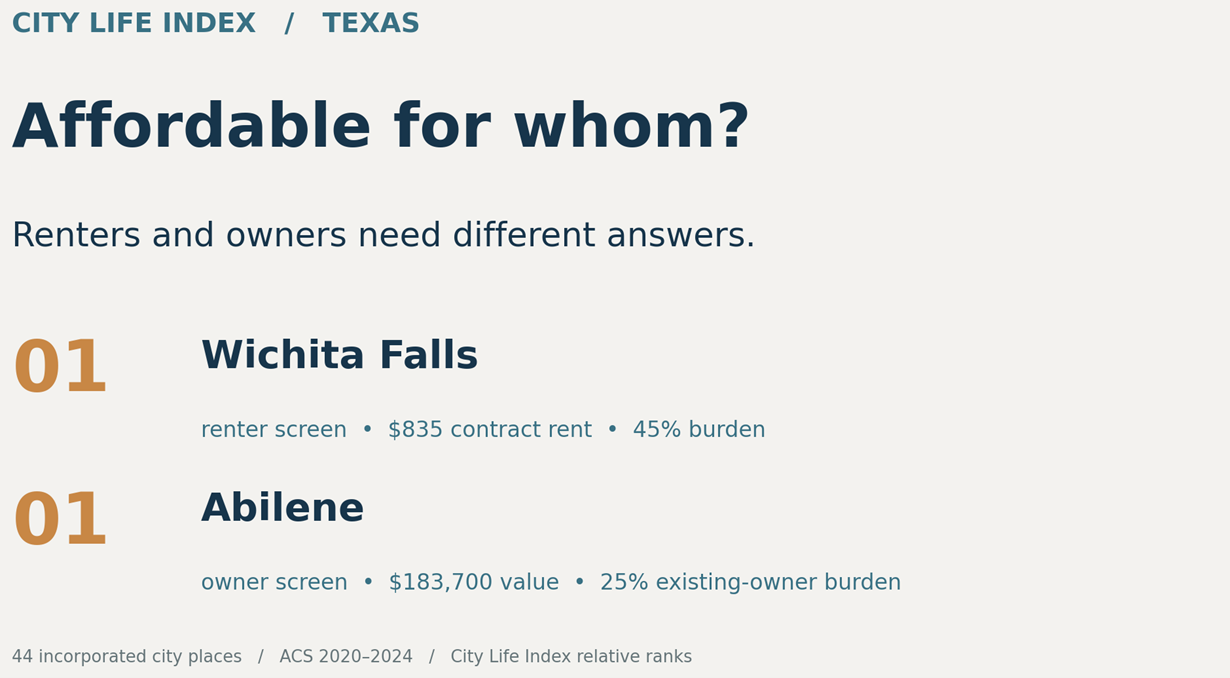
The best places to live in Texas depend on your job, budget and everyday routine. Houston, San Antonio, Dallas, Fort Worth and Austin each offer a different big-city housing and travel pattern; suburbs and regional cities widen the choices. In a 44-city Census comparison, median monthly contract rent ranges from $731 in Brownsville to $1,858 in Frisco. That is a useful search boundary, not a quote for the home you can rent now. We compare housing pressure and work trips alongside the city medians, then show how to test a shortlist against real addresses. There is no universal “best” city on these data alone.
The most useful first question is where your work and housing options overlap. An appealing citywide median can hide a difficult commute, a scarce apartment type or a neighborhood that does not fit your household. Start with the candidates below, then check the actual places you could live.
Start with the life you want
| Priority | Cities to investigate | What decides the fit |
| Large-city job search | Houston, Dallas, Fort Worth, San Antonio, Austin | The real offer, worksite, housing and travel corridor |
| Lower rent median and shorter typical trips | Wichita Falls, Amarillo, Brownsville, McAllen | Local employer depth, pay, available rentals and support network |
| North Texas suburban base | Plano, Frisco, Allen | Higher housing costs versus exact work and school locations |
| Houston-area household base | League City, Pearland, Sugar Land | Longer commute risk, insurance and property-level costs |
| Central Texas alternative | Round Rock or New Braunfels | Job location and the full rent or owner payment |
The five major cities on one consistent Census lens
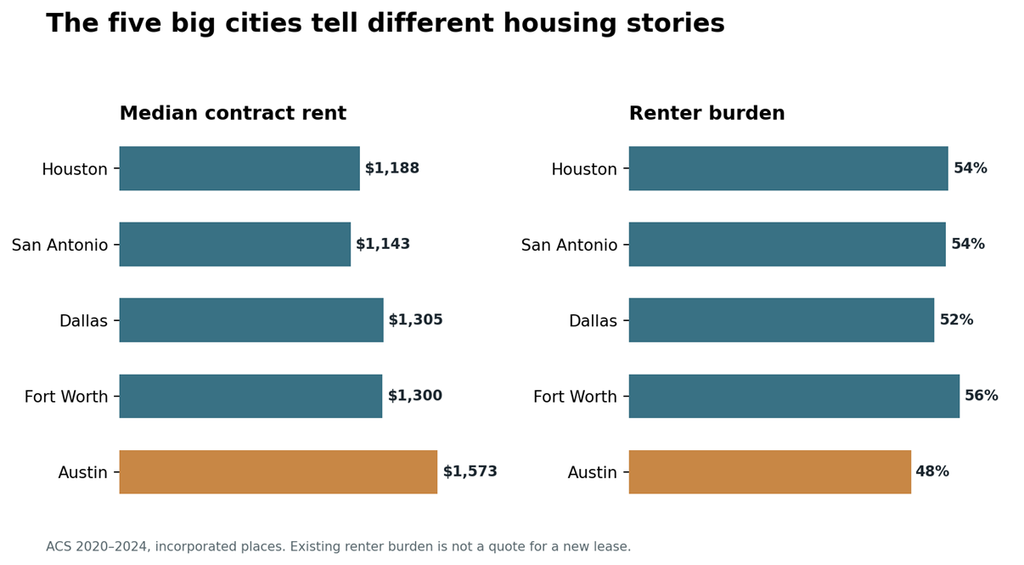
All five rows below are incorporated city places, not whole metropolitan areas. Contract rent excludes some utilities. Renter burden is the share of renter households with a computed gross-rent-to-income ratio at or above 30%; short commute is the share of workers who travel to work in under 30 minutes, excluding home workers.
| City | Contract rent | Owner value | Rent burden | Short commute |
| Houston | $1,188 | $277,800 | 54% | 57% |
| San Antonio | $1,143 | $235,700 | 54% | 66% |
| Dallas | $1,305 | $320,700 | 52% | 61% |
| Fort Worth | $1,300 | $303,000 | 56% | 59% |
| Austin | $1,573 | $555,300 | 48% | 68% |
How the five large cities differ
Houston: more housing price range, travel needs a close look
Houston’s $1,188 contract-rent median is below those of Dallas, Fort Worth and Austin. Its $277,800 owner-value median is also below those three. Yet 54% of renter households with a computed ratio are burdened, and 57% of non-home-based commuters have a trip under 30 minutes. The median is not an apartment quote, and the city boundary does not define one job market. Map the home-to-work route and get property-specific insurance costs before treating a lower city median as a saving.
San Antonio: a lower owner-value median among the five
San Antonio’s $235,700 owner-occupied value and $1,143 contract rent are the lowest in this five-city group. About 54% of renters with a computed ratio are burdened, while 66% of commuters travel under 30 minutes. A specific salary and neighborhood can change the comparison with Houston or Fort Worth; examine the full owner payment or current lease, not the median alone.
Dallas and Fort Worth: two different sides of North Texas
Dallas and Fort Worth have nearly the same contract-rent medians, $1,305 and $1,300. Dallas’s renter-burden share is about 52%, versus 56% in Fort Worth; the two shares describe existing renter households, not the same units or wages. Fort Worth’s owner-value median is $303,000 versus Dallas’s $320,700. If your work is across the region, put the office address and commute hours ahead of the city name.
Austin: a higher housing entry point with a different mix
Austin’s median contract rent is $1,573 and its owner-value median is $555,300, highest among the five. Its computed renter-burden share is about 48%, however, and 68% of commuters have a trip under 30 minutes. These facts can coexist because rent levels, incomes and the occupied housing stock differ. Do not divide the city’s median income by median rent and call the result a typical renter’s budget. Test Austin against a real offer, listing and commute.
What the 44-city comparison adds
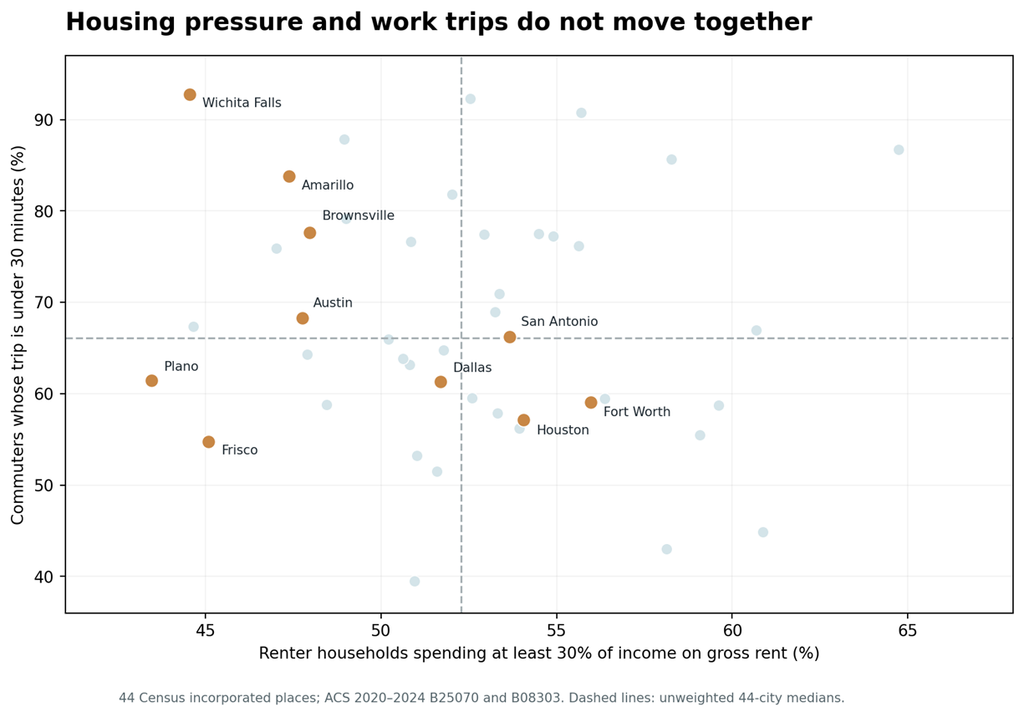
Wichita Falls and Amarillo sit on the side of the chart with lower renter burden and a larger share of short work trips: $835 and $895 median contract rent, respectively, and about 93% and 84% of commuters below 30 minutes. Those numbers make them worth investigating if a compatible job is available. They do not measure the number of openings, pay in your occupation, healthcare, schools or social fit.
Austin has a higher rent median but lands on the lower-burden, higher-short-commute side of the 44-city medians. Houston and Fort Worth fall on the higher-burden, lower-short-commute side. Brownsville combines the lowest rent median in the panel with about 48% renter burden and 78% short commutes. Each pattern tells you which questions to ask next, rather than which city to crown. The full 44-city reference table follows the article.
Choose a region before choosing a neighborhood
- North Texas: Plano and Frisco have relatively low renter-burden shares of 43% and 45%, but their contract-rent medians are $1,682 and $1,858. Confirm the job location, school boundary and a household-specific payment before choosing a suburb.
- Houston area: League City, Pearland and Sugar Land offer alternatives to the core, yet only about 53%, 39% and 52% of their non-home-based commuters respectively report trips under 30 minutes. Price the actual route and a property’s insurance.
- South and West Texas: Brownsville, McAllen, Laredo and El Paso have lower rent medians than the five large cities. Local pay, the available unit, family ties and the job offer determine whether that advantage holds for you.
- Regional cities: Wichita Falls, Amarillo, Abilene and Corpus Christi can offer different housing and travel tradeoffs. Compare the breadth of employers in your field before committing to a move.
The filters a two-axis chart cannot settle
Safety, schools, health care and climate matter, but the chart does not measure them. Texas DPS publishes reported crime by police jurisdiction; those boundaries can differ from Census places and reports are shaped by agency practices. A school assignment belongs to a specific address, not a citywide label. Use the Texas Education Agency’s campus-level reports and inspect the likely attendance boundary.
Weather and ownership risk also vary by address. North Texas has hot summers and variable precipitation, while Gulf Coast housing calls for careful storm and flood review. Check a property on FEMA’s flood map, ask for home or renter insurance terms and compare local tax bills. Texas has no state personal income tax, but property taxes are set and collected locally. These checks belong beside housing, not after a favorite city has already won.
Turn a shortlist into a decision
- Choose a realistic job or remote-work arrangement, then select three candidate cities. Resident unemployment in a Census table is not a vacancy count for your profession.
- Find two homes in each city that fit your household. Compare current rent or a total owner payment, utilities, insurance, taxes, deposits and maintenance.
- Test the route to work, care, school and family at the hours you would travel. The short-commute chart describes residents, not your prospective trip.
- Visit or check neighborhood-level information and verify school, flood and insurance details for the exact address. Change the shortlist when those facts change the budget.
Compare Texas city finalists side by side
Frequently asked questions
What is the best Texas city to live in?
There is no answer that fits every household. Begin with a realistic job location and budget, then compare city options by the housing and travel pattern you can actually use. This article offers several shortlists and no overall lifestyle ranking.
Which of the five largest city choices has the lowest housing medians?
In this five-city set, San Antonio has the lowest ACS median contract rent and owner-occupied value. Those are occupied-housing medians, not current listing prices or a full cost-of-living measure.
Is Austin more expensive than Houston?
Austin has higher city-place medians for contract rent and owner-occupied value. Yet its observed renter-burden share is lower. The difference underscores why a new mover should compare actual pay, housing, utilities and commute.
Which Texas cities may suit a tighter housing budget?
Brownsville, McAllen, El Paso, Wichita Falls and Amarillo have lower contract-rent medians than the five large city choices. Job fit and available homes can reverse the apparent advantage for an individual household.
Are suburbs always easier for commuting?
No. The Census work-trip share varies widely among suburbs, and a particular trip may cross the entire metro. Test the worksite and home address together.
Why is there no overall City Life Index score here?
The measured screen covers housing pressure and work trips. It cannot justify a single score for schools, safety, health care, job openings, climate risk and personal priorities. Site profile scores use their own methodology and should not be confused with this article’s two-axis analysis.
Bottom line
Start with the place that fits a real job and housing budget. San Antonio offers lower citywide housing medians among the five big cities; Austin has higher housing medians but a lower observed renter-burden share; Dallas, Fort Worth and Houston reward careful commute checks. Regional and suburban choices widen the field. The best city for you is the one whose actual home, travel and daily services survive that comparison.
Explore individual Texas city profiles
Disclaimer: Statistics and cost figures in this article are estimates compiled from credible public and institutional sources. Values may vary by source, geography, methodology and market conditions.