
Best Places to Live in California: 15 Major Cities Ranked
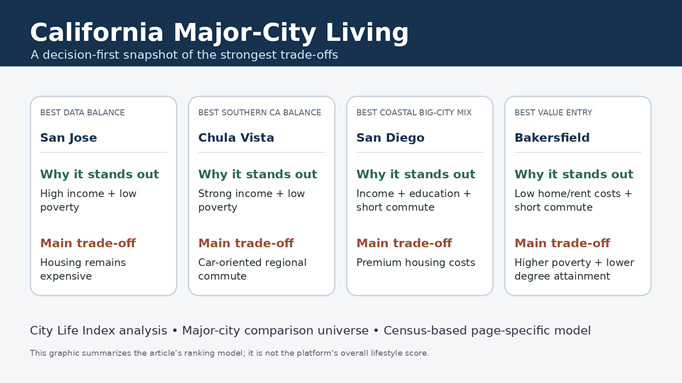
The best places to live in California depend on what you are willing to trade for housing, income, commute time and access to opportunity. For movers who want a true major-city comparison, our data-based shortlist starts with San Jose, Chula Vista, San Diego, San Francisco and Irvine – but for very different reasons. San Jose leads this page-specific balance model on income and poverty. Chula Vista performs well by combining solid household income with relatively low poverty. San Diego offers one of the strongest big-city mixes of earnings, education and commute time. Irvine is exceptionally educated and affluent, but its housing costs are a serious barrier.
This ranking focuses on 15 of California’s largest major cities instead of mixing major metros with tiny high-income enclaves. The score uses six comparable Census measures: household income, home-value-to-income ratio, rent-to-income ratio, poverty, commute time and bachelor’s-degree attainment. It is a decision aid – not a claim that one city is universally “best.”
Quick Answer
- Best overall data balance: San Jose – strongest combination of income, low poverty and educated workforce, with expensive housing as the main trade-off.
- Best Southern California balance: Chula Vista – strong income and poverty metrics without San Diego’s full housing premium.
- Best coastal big-city mix: San Diego – high income, strong education and one of the shortest commutes in the comparison.
- Best for highly educated, high-income households: Irvine – exceptional education and earnings, but the highest rent in this comparison.
- Best value-oriented choices: Bakersfield, Sacramento and Fresno – materially lower housing costs, with different trade-offs in income, poverty and climate.
At a Glance: Which California City Fits Which Priority?
| Priority | Strong candidate | Why |
| High-income career base | San Jose | Highest median household income in the comparison and low poverty; housing is still expensive. |
| Balanced Southern California living | Chula Vista | Strong income and low poverty with access to the San Diego region. |
| Coastal lifestyle + big-city opportunity | San Diego | High income, strong education and shorter commute; premium housing cost. |
| Urban career + culture | San Francisco | Very high income and education; exceptional housing costs and longer commute. |
| Family-oriented, high-education environment | Irvine | Highest degree attainment in the comparison; high rent and home values. |
| Lower-cost homeownership entry | Bakersfield | Lowest home value among the 15 and a short commute; lower education and higher poverty. |
| Best all-around inland compromise | Sacramento | Moderate housing costs and middle-of-pack income with capital-city amenities. |
| Lowest-cost large Central Valley option | Fresno | Low home values/rent and shortest commute; poverty is the main data warning. |
How the Ranking Works
The California Major-City Balance Score is a modeled, page-specific score from 0 to 100. Each city receives percentile scores within this 15-city comparison universe. Higher income and education score positively; lower housing-to-income ratio, rent-to-income ratio, poverty and commute time score positively. The weights are:
- 25% home-value-to-income affordability
- 20% renter affordability (annual gross rent / household income)
- 20% median household income
- 15% inverse poverty rate
- 10% inverse mean commute time
- 10% bachelor’s-degree attainment
The model deliberately does not include crime, climate, school quality, healthcare quality, entertainment or neighborhood-level variation. Those matter, but adding inconsistent or differently defined city-level measures would create false precision. Use the ranking to build a shortlist, then compare the factors that matter most to you.

1. San Jose – Best for high-income careers and economic resilience
San Jose takes the top spot in this major-city model because its $146,427 median household income is the highest in the group, while its 8.1% poverty rate is the lowest. Nearly half of adults 25+ hold a bachelor’s degree or higher. Those are powerful fundamentals for households prioritizing earnings and access to a highly skilled labor market.
The catch is housing. A median owner-occupied home value above $1.23 million is roughly 8.4 times median household income, and median gross rent is $2,669. San Jose works best when your career upside can absorb Bay Area housing costs.
- Balance score: 78.7/100 (page-specific modeled score)
- Home value / income: 8.4x | Annual rent / income: 21.9%
2. Chula Vista – Best for a Southern California balance
Chula Vista ranks second by combining $108,032 median household income with an 8.7% poverty rate, one of the strongest pairings in the comparison. Its median home value is below San Diego’s, although it is still expensive by national standards.
The trade-off is regional mobility: the mean commute is 28.6 minutes, and daily life can be car-dependent depending on where you work. It is a strong candidate for households that want the San Diego region but do not need to live in the central city.
- Balance score: 65.3/100 (page-specific modeled score)
- Home value / income: 7.0x | Annual rent / income: 24.8%
3. San Diego – Best coastal big-city mix
San Diego ranks third and is arguably the easiest city here to recommend to someone who wants a large coastal city without giving up strong economic fundamentals. Median household income is $108,077, bachelor’s attainment is 51%, and the mean commute is 23.5 minutes – one of the shortest in the group.
Housing remains the central constraint: the median owner-occupied home value is about $906,700, while median gross rent is $2,313. Choose San Diego when climate, coast and everyday lifestyle justify a housing premium.
- Balance score: 65.0/100 (page-specific modeled score)
- Home value / income: 8.4x | Annual rent / income: 25.7%
4. San Francisco – Best for education, urban access and high-value careers
San Francisco combines $140,970 median household income with 60.3% bachelor’s-degree attainment, second only to Irvine on education in this group. For career-driven households that value dense urban living, culture and transit access, its upside is difficult to reproduce elsewhere in California.
The cost barrier is equally hard to ignore. Median owner-occupied home value is nearly $1.4 million, and median gross rent is $2,476. The city scores well in the model because income and education are unusually strong, but affordability can still dominate a real household budget.
- Balance score: 64.0/100 (page-specific modeled score)
- Home value / income: 9.9x | Annual rent / income: 21.1%
5. Irvine – Best for highly educated, high-income households
Irvine stands out with 70.6% bachelor’s-degree attainment, the highest of the 15 cities, plus $136,719 median household income. Its mean commute of 24.7 minutes is also relatively manageable for a large employment center in Southern California.
The constraint is price. Median gross rent reaches $2,997, the highest in this comparison, and median owner-occupied home value is about $1.19 million. Irvine is strongest for higher-income households that value a highly educated environment and can afford Orange County housing.
- Balance score: 62.5/100 (page-specific modeled score)
- Home value / income: 8.7x | Annual rent / income: 26.3%
6. Bakersfield – Best value for buyers who prioritize space and a short commute
Bakersfield rises to sixth because the model rewards housing value and commute time. Its median owner-occupied home value is about $371,700, the lowest of the 15, and its 23.6-minute mean commute is among the shortest. Median rent is also comparatively low at $1,472.
The trade-offs are important: poverty is 16.3%, and bachelor’s attainment is 23.6%. Bakersfield is not the all-purpose winner, but it can be compelling for buyers whose top priority is lowering housing cost rather than maximizing coastal amenities or degree-heavy job markets.
- Balance score: 60.0/100 (page-specific modeled score)
- Home value / income: 4.6x | Annual rent / income: 21.9%
7. Sacramento – Best inland all-around compromise
Sacramento is one of California’s most practical compromise cities. A median home value around $506,300 is far below the major coastal cities in this ranking, while median household income is $87,321 and bachelor’s attainment is 37.1%, matching the statewide benchmark used here.
It does not dominate any single metric, and that is partly the point. Sacramento works for people who want a full-service city, state-government employment base and Northern California access without Bay Area home prices. The major lifestyle trade-off is an inland climate rather than a coastal one.
- Balance score: 57.3/100 (page-specific modeled score)
- Home value / income: 5.8x | Annual rent / income: 24.4%
8. Oakland – Best for Bay Area access with strong income and education
Oakland posts $101,600 median household income and 48.7% bachelor’s attainment, both strong numbers. Its location keeps it tightly connected to the wider Bay Area economy and culture.
Affordability remains difficult: the median owner-occupied home value is about $929,900, and the mean commute is 29.8 minutes. Oakland can make sense for people prioritizing Bay Area access and urban diversity, but it does not solve the region’s basic housing-cost problem.
- Balance score: 55.0/100 (page-specific modeled score)
- Home value / income: 9.2x | Annual rent / income: 23.4%
9. Fresno – Best for low housing cost and short commute
Fresno has one of the clearest affordability stories in the group: median owner-occupied home value is about $374,800, median gross rent is $1,421, and its 22.4-minute mean commute is the shortest of all 15 cities.
The counterweight is household economics. Median income is $70,991, the lowest in the comparison, and poverty is 20.1%, the highest. Fresno is a strong value candidate when lower housing cost matters most, but it needs a careful job and neighborhood check before a move.
- Balance score: 51.7/100 (page-specific modeled score)
- Home value / income: 5.3x | Annual rent / income: 24.0%
10. Santa Ana – Best for Orange County access with relatively strong household income
Santa Ana combines $93,999 median household income with a 10.8% poverty rate and a relatively short 24.5-minute commute. Those fundamentals keep it competitive despite Orange County housing costs.
Its median home value of about $713,000 and median rent of $2,082 are still substantial, while bachelor’s attainment is 18.3%, the lowest in the comparison. It may fit households tied to Orange County jobs more than movers choosing freely across the whole state.
- Balance score: 50.8/100 (page-specific modeled score)
- Home value / income: 7.6x | Annual rent / income: 26.6%
11. Riverside – Best for Inland Empire access and more attainable ownership
Riverside offers a middle ground between coastal Southern California pricing and Central Valley affordability. Median owner-occupied home value is $584,800, with median household income of $91,045.
The biggest penalty is commute time: 31.3 minutes, one of the longest in the group. Riverside is a stronger fit when you can work locally, hybrid or remotely; long regional commutes can erase part of the housing-value advantage.
- Balance score: 50.7/100 (page-specific modeled score)
- Home value / income: 6.4x | Annual rent / income: 25.2%
12. Stockton – Best for lower purchase prices within Northern California corridors
Stockton’s median owner-occupied home value is about $440,900, making it one of the more attainable major-city markets in the ranking. Median gross rent is $1,577.
Its 31.7-minute mean commute is the longest of the group, poverty is 15.5%, and bachelor’s attainment is 20%. The city can work for housing-first decisions, but the model flags weaker economic and mobility fundamentals than the top-ranked choices.
- Balance score: 45.0/100 (page-specific modeled score)
- Home value / income: 5.5x | Annual rent / income: 23.7%
13. Anaheim – Best for Orange County employment and entertainment access
Anaheim brings $95,227 median household income and central Orange County access, with a 27.4-minute mean commute. For households already connected to the area’s employment base, location can be the decisive advantage.
The affordability math is less favorable: median home value is about $831,200 and median gross rent is $2,175. In this model, those costs are high relative to household income, which pushes Anaheim down the ranking.
- Balance score: 40.3/100 (page-specific modeled score)
- Home value / income: 8.7x | Annual rent / income: 27.4%
14. Long Beach – Best for a coastal urban lifestyle near Los Angeles
Long Beach offers a distinctive mix of coastline, urban neighborhoods and access to the Los Angeles region. Median household income is $87,430, and bachelor’s attainment is 35.6%.
The model penalizes its housing-to-income ratio: median owner-occupied home value is about $806,600 while median gross rent is $1,871. Long Beach can be a lifestyle winner for the right person even though it is not an affordability winner in this data framework.
- Balance score: 34.7/100 (page-specific modeled score)
- Home value / income: 9.2x | Annual rent / income: 25.7%
15. Los Angeles – Best for maximum scale, career variety and culture – if budget is secondary
Los Angeles finishes last in this economic-balance model, but that should not be read as “worst place to live.” The city offers unmatched scale within California for entertainment, creative work, dining, neighborhoods and regional opportunity. Its breadth is exactly why many people accept the friction.
The score reflects the measurable trade-offs: median home value is $921,200 against median household income of $81,939, poverty is 16.5%, and the mean commute is 30.7 minutes. Choose Los Angeles when its specific career and lifestyle advantages are worth paying for – not because a generic ranking says you should.
- Balance score: 19.0/100 (page-specific modeled score)
- Home value / income: 11.2x | Annual rent / income: 28.3%
What the Data Says About California Housing Trade-offs
The strongest pattern is not simply “coast expensive, inland cheap.” The more useful question is whether local income keeps pace with housing. San Jose and San Francisco have very high home values, but also the two highest household incomes in the comparison. Los Angeles has a different problem: its home value is high while median household income is much lower than those Bay Area peers. That produces one of the weakest owner-affordability ratios in this 15-city set.
For renters, Irvine has the highest median gross rent in the group, followed by San Jose and San Francisco. Fresno and Bakersfield sit at the opposite end. But rent alone is incomplete: pairing rent with household income gives a better first-pass view of budget pressure.

Best California Major Cities by Type of Mover
For families
Start with Irvine, Chula Vista, San Diego and Sacramento, then evaluate neighborhood-level school quality, childcare, commute and housing size. Irvine’s education and income metrics are exceptional, while Chula Vista combines strong income with low poverty. The ranking does not include school-district performance, so families should not treat the city score as a school score.
For young professionals
San Jose, San Francisco, San Diego, Oakland and Los Angeles offer the strongest big-city career and network upside, but the housing math differs sharply. San Jose and San Francisco pair high costs with very high incomes; Los Angeles offers enormous career variety but performs poorly on housing-to-income and commute in this model.
For budget-conscious buyers
Bakersfield, Fresno, Stockton and Sacramento deserve the first look. Bakersfield and Fresno have the lowest home values in this set, while Sacramento offers a more balanced city profile at a higher price. Check local job fit before assuming a lower home price automatically creates a better life.
For people who want coastal living
San Diego is the strongest all-around coastal major-city candidate in this model. Long Beach can be attractive for Los Angeles-region access and a more compact coastal identity, while San Francisco offers a very different dense, transit-oriented urban experience at a much higher housing cost.
Decision Framework: How to Choose
- Choose San Jose if maximizing income and career upside matters more than getting a low home price.
- Choose Chula Vista if you want the San Diego region with strong household fundamentals and can accept a regional commute.
- Choose San Diego if you want the strongest blend of coast, big-city amenities, education and manageable commute among the top-tier choices.
- Choose Irvine if schools/education environment, planned-community living and high household income justify premium housing.
- Choose Sacramento if you want a more balanced Northern California budget without dropping to a smaller-city lifestyle.
- Choose Bakersfield or Fresno if housing cost is the main constraint and you can verify that local work, climate and neighborhood fit meet your needs.
- Choose Los Angeles only when the city’s specific career, cultural or network advantages are important enough to outweigh its housing and commute penalties.
Pros and Cons of Living in California’s Major Cities
| Advantages | Trade-offs |
| Exceptional job-market diversity across technology, entertainment, healthcare, government, logistics and education. | Housing costs can be extreme, especially in the Bay Area, coastal San Diego and Orange County. |
| Large range of lifestyle choices: dense urban, coastal, suburban and inland. | Commute time and car dependence can materially affect daily life. |
| High-income opportunities in several major metros. | High income does not automatically translate into affordability when home prices are also very high. |
| Multiple lower-cost major-city alternatives exist inland. | Lower-cost inland cities may trade off income, climate comfort, education metrics or access to certain industries. |
Bottom Line
For a major-city-only answer to where to live in California, San Jose leads this Census-based balance model, while Chula Vista and San Diego provide strong Southern California alternatives. Irvine and San Francisco are excellent fits for higher-income households that can absorb housing costs. Sacramento is the most straightforward inland compromise, and Bakersfield or Fresno deserve attention when affordability comes first. Los Angeles remains a powerful lifestyle and career choice, but its housing-to-income and commute trade-offs are too large to ignore.
The right move is not to copy the ranking from top to bottom. Use it to eliminate cities that fail your non-negotiables, then compare your top two to four choices on neighborhoods, commute, schools, climate, healthcare, safety and the specific jobs or communities you need.
| STATISTICS DISCLAIMER Statistics and cost figures in this article are estimates compiled from reliable and credible public, government, institutional and industry sources. Values may vary by source, geography, methodology and market conditions. The California Major-City Balance Score is a City Life Index model derived from sourced data and is not an official government measurement. |