
Moving to California: Choose a City and Plan the Move
Moving to California starts with a narrower question: which job, housing choice and ordinary week will work for your household? California’s major cities differ sharply in rent and income, and a state average cannot tell you what a lease, commute or insurance quote will cost at one address. This guide compares the state’s 20 largest incorporated cities on the same Census measures, then gives you a practical sequence for choosing a place, checking a real budget and handling the move. Use the numbers to make a shortlist, not to decide from a ranking alone.
Quick answer
Choose two or three regions tied to your work and daily needs. Compare city-level housing and income only as a starting screen. Before you commit, get an actual rental or purchase cost, calculate take-home pay, test the trip to work and essential services, and check insurance and hazards for the address. Arrange coverage and California paperwork around your move date.
Five things to know before choosing a city
- California is not one housing market: the state median gross rent is $2,036, while the 20 major-city figures span $1,421 in Fresno to $2,997 in Irvine. These are survey medians, not live asking rents.
- A lower rent does not prove an easier budget. Median household income also differs, and the household that is moving may earn far more or less than the local median.
- A cheaper city can become expensive if the real commute, car ownership, parking, childcare or insurance changes. Test the exact locations and hours.
- Climate and hazard choices belong at the address level. Check local weather, air quality, wildfire zones, flood maps and insurability before signing.
- The move itself has deadlines: an out-of-state vehicle generally needs California registration within 20 days; a qualifying health coverage move may allow a 60-day special-enrollment window. Check your circumstances with the agencies.
Compare major California cities on the same measures
The table samples ten different major-city options from a 20-city screen. It combines Census QuickFacts estimates for each incorporated city. Rent is median gross rent, which includes contract rent plus certain utilities. The income column is a median of households in the city; the commute is a mean among workers. None is a quote for your household.
| City | Gross rent / mo | Household income | Mean commute, min | Rent / income* |
| Fresno | $1,421 | $70,991 | 22.4 | 24.0% |
| Bakersfield | $1,472 | $80,540 | 23.6 | 21.9% |
| Stockton | $1,577 | $79,907 | 31.7 | 23.7% |
| Sacramento | $1,779 | $87,321 | 25.3 | 24.4% |
| Riverside | $1,914 | $91,045 | 31.3 | 25.2% |
| Los Angeles | $1,933 | $81,939 | 30.7 | 28.3% |
| Oakland | $1,979 | $101,600 | 29.8 | 23.4% |
| San Diego | $2,313 | $108,077 | 23.5 | 25.7% |
| San Francisco | $2,476 | $140,970 | 30.4 | 21.1% |
| San Jose | $2,669 | $146,427 | 27.3 | 21.9% |
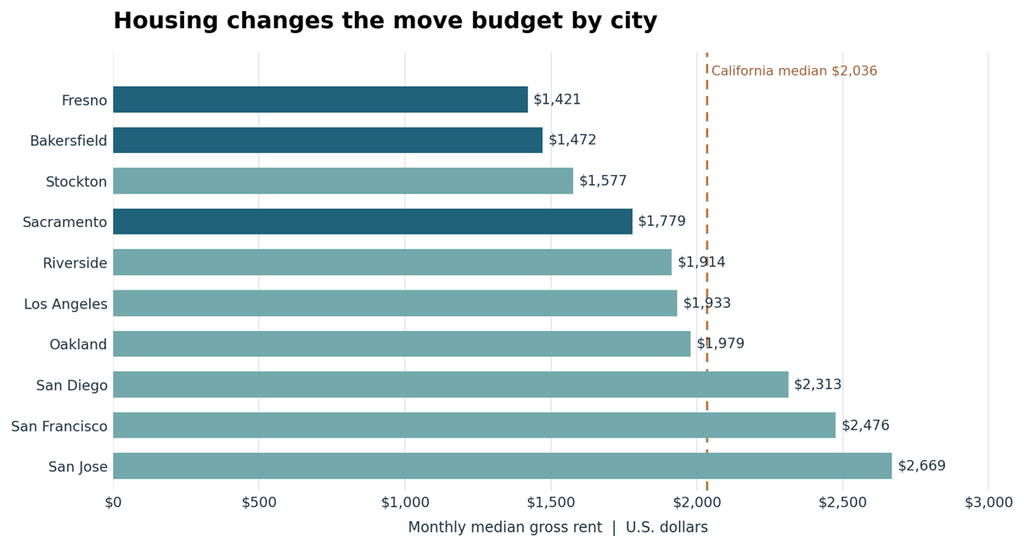
The first useful contrast is Fresno and San Francisco. Fresno’s city median rent is about 43% lower, calculated from $1,421 and $2,476, but its household-income median is about half of San Francisco’s. Their simple rent-to-income ratios are 24.0% and 21.1% respectively. That is a reason to compare a personal job offer and housing quote, not proof that one city is easier for all residents.
Match a region to your work and routine
Bay Area
San Francisco, San Jose and Oakland each have different housing figures, and the wider region cannot be represented by one downtown address. If a specific job or family network pulls you here, compare a realistic salary and unit first, then test neighborhood-to-work travel. San Jose’s city median rent is $2,669; Oakland’s is $1,979. Those city medians do not describe every neighborhood or unit.
Los Angeles and nearby cities
Los Angeles, Long Beach, Anaheim and Santa Ana are separate cities in the screen. A move across this region can change the daily route as much as the housing price. Start with an employer location and a short list of workable travel corridors, then compare actual units. The citywide mean commute in Los Angeles is 30.7 minutes, but an individual trip can be very different.
San Diego region
San Diego and Chula Vista offer distinct housing and commute baselines. San Diego’s median gross rent is $2,313 and Chula Vista’s $2,229. If coastal access is a priority, price a unit that actually meets your space and route needs; do not pay for a lifestyle feature you will seldom use.
Capital, Central Valley and inland Southern California
Sacramento, Fresno, Stockton, Modesto and Bakersfield provide several lower-rent screens among the state’s largest cities. Riverside, San Bernardino and Fontana add inland Southern California options. The tradeoffs are personal: local job access, heat and air quality, family ties, and a particular route may matter more than a city median. Treat a lower rent as a candidate to test, not a recommendation to commute to a different metro.
Build the move budget from your actual offer
Start with monthly take-home income for the people who will actually move. Then subtract a housing quote for an available unit or property, utilities, insurance, transport and parking, childcare, health coverage, food, debt payments and a reserve. Add one-time cash for the mover, travel, deposits, utility setup and time between paychecks. A mortgage payment alone omits taxes, insurance, maintenance and closing cash.
- Renting: compare the full lease, utilities, parking, pet charges and move-in cash against your monthly budget. Confirm the unit and terms in writing.
- Buying: compare lender Loan Estimates for the same property and obtain an insurance quote before treating a listing price as affordable.
- Working: verify the job’s location, pay, schedule and remote-work policy. Use California EDD metro and occupation data to examine an area, but do not substitute a metro job trend for your own offer.
- Moving: for an interstate mover, collect written estimates and check the company’s federal registration and complaint record through FMCSA.
For the deeper numbers, see the California cost guide and housing guide. Those pages explain statewide context and the rent-versus-buy decision; this guide helps put the pieces in move order.
Inspect the address, not just the city
A city’s average commute is not your commute, and a fire hazard map is not an insurance quote. Run the trip at the hours you would travel. Check the actual property in the CAL FIRE hazard viewer and FEMA flood map; request insurance terms for that address. Compare NOAA station climate normals, local AirNow conditions, and, if you have children, the school or district records and assignment rules. Each tool answers a different question.
Safety also varies at a smaller scale than a city label. Review recent local public-safety information, visit at the times you expect to be out, and inspect the block and building. Do not infer a particular property’s risk from a statewide or citywide ranking.
A California move checklist that follows the decision
Before signing or booking
- Choose two or three cities tied to a plausible job, remote arrangement or family support; compare real housing and income rather than a statewide average.
- View or verify the actual unit, lease and move-in charges. For a purchase, check finance, insurance, taxes, hazards and inspections.
- Test the commute and essential errands; compare healthcare networks and school assignments if they matter to your household.
- Get several written interstate moving estimates, confirm mover registration, and choose the move date around housing and work.
Around arrival
- Arrange utility and internet start dates, update your mailing address, and keep lease, employment and vehicle papers accessible.
- If you drive, use California DMV’s new-resident portal for the license application and out-of-state vehicle registration. The DMV states a 20-day registration window after becoming a resident or bringing the vehicle to California; check your exact trigger and vehicle requirements.
- Review California auto coverage. The state’s standard minimum liability limits are $30,000/$60,000 for bodily injury and $15,000 for property damage; higher coverage may fit your risk.
In the first weeks
- If you need individual coverage, check Covered California promptly: a qualifying move to or within California generally has a 60-day special enrollment window. Employer coverage and Medi-Cal have their own processes.
- Track the date you became a resident and California-sourced income; a part-year resident may need Form 540NR. California’s tax residency test is fact-specific, so use FTB guidance or a qualified adviser for a complex move.
- Recheck the budget after actual utility, transport and grocery bills arrive, and adjust the city or housing plan if the margin is too small.
Choose a place by the constraint that matters most
| Your constraint | First places to compare | Required reality check |
| A job in a specific metro | Cities near the worksite, not statewide “best” lists | Housing quotes and a timed route from each address. |
| A lower initial rent screen | Fresno, Bakersfield, Stockton or San Bernardino | Local pay, climate, air, insurance and exact home options. |
| Coast and daily outdoor access | San Diego or a suitable coastal neighborhood | Space, actual travel and total housing cost. |
| State-capital access with a different housing baseline | Sacramento and its actual job corridor | Compare income, heat and commute against other candidates. |
| Family support or schools | The city containing the real support network | School assignment, care logistics and the family’s full budget. |
These are starting points, not rankings or guarantees. An offer in one area may beat a lower-priced city where the work, care or daily routine does not fit. Use the site’s city profiles and Compare Cities tool for a second pass.
Frequently asked questions
How much money do I need to move to California
There is no responsible statewide amount. Budget for the selected home’s move-in or closing cash, moving and travel quotes, insurance, utilities and a reserve, then test the recurring costs against after-tax pay. Census rent is a research screen, not a lease quote.
What is the cheapest major city in this comparison
Fresno has the lowest median gross rent, $1,421, among these 20 cities. Bakersfield has the lowest median owner-occupied value, $371,700. “Cheapest” depends on whether you rent or buy and on your own income, route and address.
Can I move before getting a California job
You can plan that move, but the budget needs a realistic income source and enough cash to cover the search period. Check area-specific occupations and employment through EDD, and price housing based on what a landlord or lender would accept, not the city median.
Do I need a car
It depends on your exact home, job, transit service and caregiving needs. Try the route at working hours and compare the cost of parking, car insurance, transit and extra travel time. A citywide commute average cannot answer this for you.
When should I register an out-of-state car
California DMV says an out-of-state vehicle must generally be registered within 20 days of becoming a resident or bringing it into the state. Check its new-resident guidance for the applicable trigger, documentation and vehicle requirements.
What should I check before choosing a neighborhood
Verify the unit, real commute, current insurance availability, wildfire and flood information, air quality, school assignment where relevant, and the services you use weekly. These checks are property- and household-specific.
Bottom line
Pick the California city that still works after your job, home, route and risk checks. The matched 20-city numbers are useful for narrowing the field; they cannot replace a real lease or purchase quote and a week that fits your household. Shortlist two or three places, compare them on the same personal budget, and move when the full plan holds together.
Compare your finalists in City Life Index and open the California state profile for the next layer of city research.
Disclaimer: Statistics and cost figures in this article are estimates compiled from reliable public and government sources. Values may vary by source, geography, methodology and market conditions. The City Life Index rent-to-income figures are calculations from separate city medians, not personal affordability quotes. Confirm current agency rules and property-specific terms before acting.